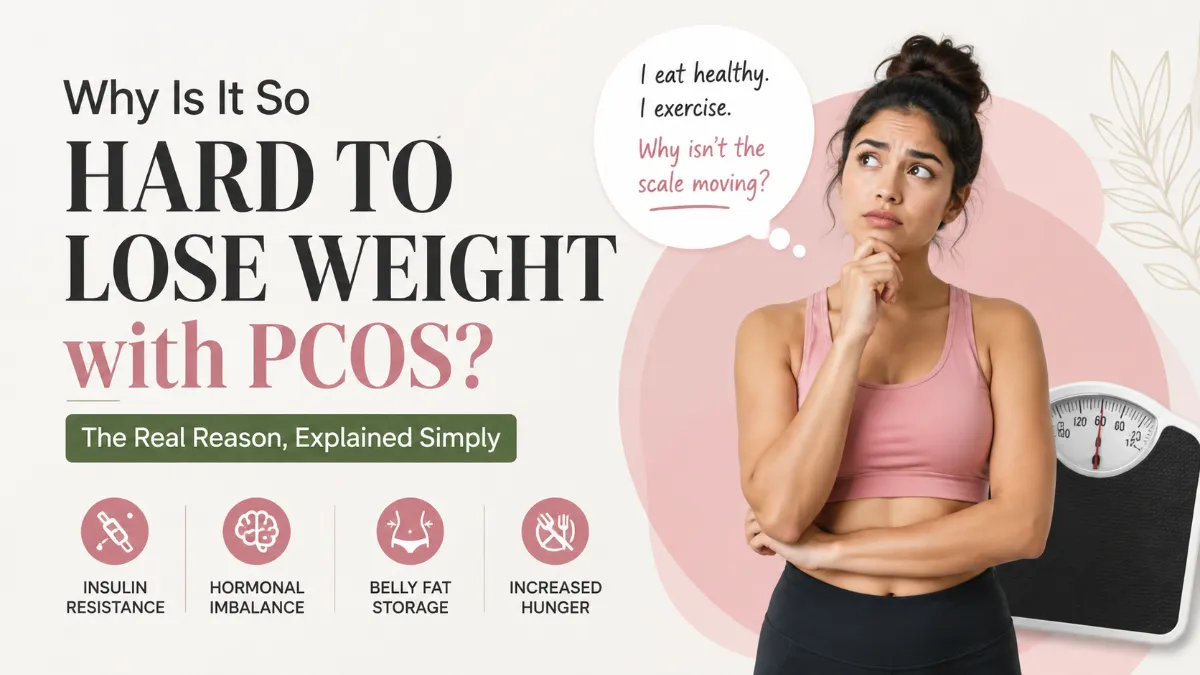
You cut sugar. You started walking every morning. You counted calories for three months straight and barely touched dessert. The scale didn't move. Some weeks it went up.
If that sounds familiar, the problem isn't your willpower.
Polycystic ovary syndrome changes how your body handles insulin, hunger signals, and fat storage at a hormonal level. That's why standard "eat less, move more" advice, the kind that works for a friend without PCOS, often stalls out for you. This article explains what's actually happening inside a PCOS body, using published research instead of guesswork, and what genuinely helps.
Quick Answer
Weight loss is harder with PCOS mainly because of insulin resistance, which shows up in clamp studies in roughly 75% of women with the condition. High insulin levels push the body to store fat, especially around the abdomen, and blunt the hunger signals that normally tell you to stop eating. Add leptin resistance and higher androgen levels on top of that, and the body actively works against the same calorie deficit that works for someone without PCOS.
What's Actually Different Inside a PCOS Body
PCOS isn't a single problem with a single fix. It's a cluster of hormonal shifts that all push in the same direction: more fat storage, more hunger, and less energy burned at rest. Four of these matter most for weight.
Insulin resistance, present in the majority of women with PCOS regardless of body size
Leptin resistance, which keeps the brain's "I'm full" signal from registering properly
Lower resting energy burn in some women, tied to reduced muscle mass and insulin resistance
Higher androgen levels, which redirect fat storage toward the abdomen
Each one reinforces the others. Here's how, one at a time.
Reason 1: Insulin Resistance Turns Your Body Into a Fat-Storage Machine
Insulin's normal job is simple. After you eat, it acts like a key that unlocks your cells so glucose can move out of your bloodstream and into muscle, liver, and fat cells for use or storage.
In insulin resistance, the lock gets stiff. Cells stop responding to normal amounts of insulin, so glucose stays in the blood longer than it should. The pancreas compensates by pumping out more insulin to force the door open. That excess insulin doesn't just sit there quietly.
It does three things at once, and none of them help weight loss. It tells fat cells to store more fat and release less of it for energy. It raises androgen production in the ovaries. And it keeps hunger signaling turned up, because your cells are technically starved of usable glucose even while your blood sugar is high.
Research using the gold-standard clamp method has documented insulin resistance in up to 75% of women with PCOS, independent of whether they're classified as overweight. This is one reason why some women with PCOS at a completely normal weight still struggle with the same fat-storage and hunger patterns as women who carry more weight.
Normal Insulin Response vs. PCOS Insulin Response
Stage | Without Insulin Resistance | With PCOS-Related Insulin Resistance |
|---|---|---|
After a meal | Insulin rises briefly, moves glucose into cells efficiently | Insulin rises higher and stays elevated longer |
Fat storage | Balanced storage and release | Fat storage favored, fat release suppressed |
Hunger signal | Settles within a couple of hours | Stays activated, cravings return sooner |
Ovarian effect | Minimal | Stimulates excess androgen production |
Reason 2: Leptin Resistance Keeps the "Full" Signal Stuck Off
Leptin is made by fat cells and travels to the brain to say, in effect, enough food has come in. In a well-functioning system, rising leptin after meals dials down appetite.
Several case-controlled studies have found that women with PCOS often have higher circulating leptin than women without the condition at the same body mass index, and that leptin levels correlate closely with insulin resistance markers like HOMA-IR. Higher leptin sounds like it should mean less hunger. In practice, it often means the opposite, because the brain's leptin receptors become less responsive, a pattern researchers call leptin resistance. The message is being sent. It's arriving faint or not at all.
This is why so many women with PCOS describe a specific, frustrating symptom: eating a full meal and still feeling hungry twenty minutes later. That's not a lack of discipline. It's a signaling problem.
Reason 3: Some Women With PCOS Burn Fewer Calories at Rest (the Evidence Is Mixed)
This is the part most PCOS articles oversimplify. A slower metabolism is often blamed for PCOS weight struggles, and the research is genuinely mixed rather than settled in one direction.
A 2009 study published in Fertility and Sterility measured basal metabolic rate in 91 Greek women with PCOS against 48 age- and BMI-matched women without it. The women with PCOS who also had insulin resistance burned noticeably fewer calories at rest than the control group. A separate 2013 study from Cedars-Sinai found lower basal metabolic rates in PCOS even after adjusting for BMI, and linked this to lower lean body mass and less muscle in the legs specifically. But a 2015 Clinical Endocrinology study using a different measurement method found no significant difference in resting metabolic rate once age and BMI were accounted for.
The honest takeaway: metabolic rate isn't uniformly lower in every woman with PCOS, but it can be meaningfully lower in the subset with both insulin resistance and reduced muscle mass. That subset is large enough to explain why so many women report the same experience, eating the same amount as people around them yet gaining weight more easily.
Curious where your own number might fall? Our BMR calculator estimates resting energy burn based on your age, weight, and height, so you can compare it against the study figures below.
What the Research Found (Adjusted BMR, kcal/day)
Study Group | Adjusted BMR | Source |
|---|---|---|
Control group (no PCOS) | 1,868 kcal/day | Georgopoulos et al., Fertility and Sterility, 2009 |
PCOS, no insulin resistance | 1,590 kcal/day | Georgopoulos et al., Fertility and Sterility, 2009 |
PCOS, with insulin resistance | 1,116 kcal/day | Georgopoulos et al., Fertility and Sterility, 2009 |
Reason 4: Extra Androgens Push Fat Straight to the Belly
Higher androgen levels, the male-pattern hormones like testosterone that are often elevated in PCOS, don't just cause acne and unwanted hair growth. They change where fat gets stored, favoring the abdomen over the hips and thighs.
Abdominal, visceral fat behaves differently from fat stored elsewhere. It's more metabolically active and releases more inflammatory signals into the bloodstream. Those inflammatory signals worsen insulin resistance. Worse insulin resistance raises androgen production further. The loop closes on itself.
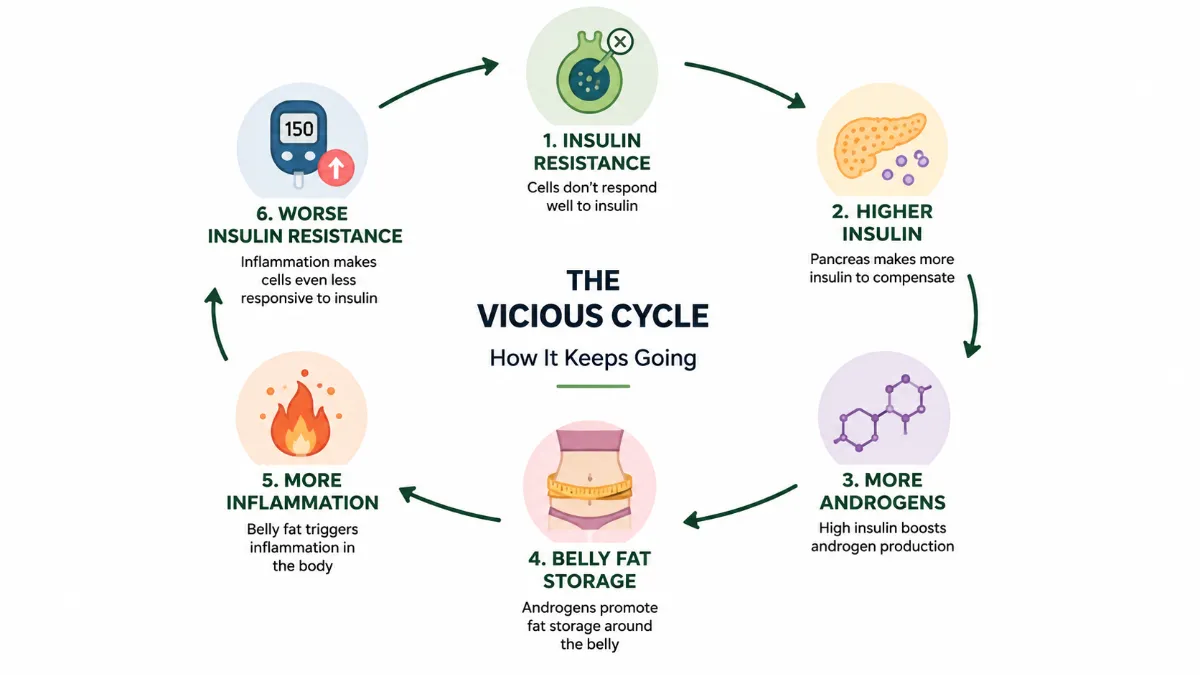
The Cycle, Step by Step
Insulin resistance causes the pancreas to release more insulin than usual.
Excess insulin signals the ovaries to produce more androgens.
Higher androgens direct fat storage toward the abdomen.
Visceral abdominal fat releases inflammatory compounds into the bloodstream.
Inflammation worsens insulin resistance, restarting the cycle at a slightly worse baseline.
Breaking this cycle anywhere along the loop, not only through food, is what actually moves the needle. That's the strategy section below.
Why "Eat Less, Move More" Advice Backfires for PCOS
A standard calorie deficit assumes a body that responds to hunger and fullness signals in a predictable way. That assumption breaks down once insulin resistance and leptin resistance are in the picture.
Cut calories hard, and a PCOS body reads that as a threat rather than a plan. Blood sugar swings become sharper on a low-calorie diet when insulin is already elevated, which triggers stronger cravings, not weaker ones. Restrictive dieting also risks losing muscle along with fat, and muscle loss lowers resting energy burn even further, compounding the exact problem described in the metabolic rate research above. Several clinicians who treat PCOS now steer patients away from aggressive calorie-cutting for this reason, favoring steadier changes to food composition and insulin sensitivity instead of the number on the scale.
This also explains a pattern many women recognize. A crash diet produces fast results for the first two or three weeks, then stalls hard, then reverses once normal eating resumes. The body isn't being stubborn. It's protecting itself from what looks like a shortage.
PCOS Isn't the Same for Every Woman: Why Phenotype Matters
PCOS is diagnosed under the Rotterdam criteria, which require at least two of three features: irregular or absent ovulation, elevated androgens, and polycystic ovaries on ultrasound. Because only two of three are required, two women can both carry a PCOS diagnosis while having fairly different underlying drivers.
Insulin-resistant phenotype: the most common pattern, often with more visible weight gain and stronger cravings
Lean or "non-insulin-resistant" phenotype: normal or low BMI, but still capable of hormonal and ovulatory symptoms
Post-pill or adrenal-driven presentations: androgens originate more from the adrenal glands than the ovaries
Inflammatory-driven presentations: chronic low-grade inflammation plays a larger role than insulin alone
This matters for weight loss because a plan built entirely around insulin resistance may do little for a woman whose main driver is adrenal or inflammatory. A fasting insulin test, a full hormone panel, and a conversation with a doctor about which pattern fits your case will do more for a personalized plan than another generic PCOS diet list.
Common Mistakes That Slow Progress Further
A few patterns show up again and again in women who feel stuck, and most of them are reasonable ideas that don't fit the PCOS picture.
Chasing diets under 1,000 calories a day, which trigger the stress response described above
Doing cardio alone while skipping strength training, missing the muscle-building effect that improves insulin sensitivity
Treating supplements like inositol or berberine as a substitute for a confirmed insulin-resistance diagnosis, rather than an addition to it
Weighing daily and reacting to normal water-weight fluctuation as if it were fat gain
Ignoring sleep and stress while focused entirely on food
How Much Weight Do You Actually Need to Lose?
This is the good news buried inside all of this. You don't need to reach a specific number on a chart. Research consistently shows that modest weight loss produces disproportionate symptom improvement in PCOS.
Weight Lost | Example (for a 70 kg / 154 lb woman) | Documented Benefit |
|---|---|---|
2% to 5% | 1.4 to 3.5 kg (3 to 7.7 lb) | Improved insulin sensitivity, some symptom relief (GoodRx-cited research review) |
5% to 10% | 3.5 to 7 kg (7.7 to 15.4 lb) | More regular periods, improved ovulation and fertility, better insulin sensitivity (multiple clinical sources) |
Ongoing loss beyond 10% | 7+ kg (15+ lb) | Continued improvement in hormonal and metabolic markers, though gains per kilo tend to level off |
BMI won't tell you about insulin resistance or where your fat is distributed, but it's a reasonable starting point for the percentage math above. Use our BMI calculator to find your 5% and 10% weight-loss targets in kilos or pounds.
A 2019 study in Clinical Medicine Insights: Reproductive Health found that a 5% reduction in body weight produced measurable improvements across reproductive, hormonal, and metabolic markers in women with PCOS. That's a smaller, more achievable target than most PCOS content leads you to expect.
What Actually Works for PCOS Weight Loss
None of this means diet and exercise are pointless. It means the target has to be insulin sensitivity first, and the scale second.
Food Approach
Meals built around protein and fiber at the same time slow the glucose spike that triggers excess insulin release. This matters more for PCOS than for someone without insulin resistance, because the same plate of food produces a larger insulin response in a PCOS body. Refined carbohydrates and sugary drinks tend to be the biggest single trigger for that spike, so trimming those first, rather than cutting total calories aggressively, tends to produce steadier results.
Not sure what that looks like on a plate? Our macro calculator breaks down a protein-and-fiber-forward day based on your own numbers, so you're building meals around insulin sensitivity rather than a calorie target.
Movement
Strength training deserves more attention than cardio in PCOS specifically, because muscle tissue is one of the biggest users of glucose in the body. More muscle means more places for glucose to go besides fat storage. This lines up directly with the earlier research on lower lean muscle mass contributing to reduced resting energy burn. Two to three resistance sessions a week, combined with regular walking, is a realistic starting point.
Sleep and Stress
Cortisol, the stress hormone, raises blood sugar and can worsen insulin resistance over time. Poor sleep does something similar. Neither one gets fixed by a meal plan, which is why sleep quality and stress load are now treated as core parts of PCOS management rather than side notes.
Medical Support
Lifestyle changes alone often aren't enough to move insulin resistance, and that's not a personal failure. Metformin is commonly prescribed to improve insulin sensitivity in PCOS. GLP-1 medications, including semaglutide, are gaining use in PCOS-related obesity: a clinical study found that after three months of treatment, roughly 80% of obese PCOS patients unresponsive to lifestyle programs alone achieved at least a 5% reduction in body weight, with an average loss of 7.6 kg. These medications require a doctor's evaluation and monitoring, and they're not automatically right for everyone.
Strategy | Why It Works for PCOS | Effort Level |
|---|---|---|
Protein + fiber per meal | Blunts insulin spike from carbohydrates | Low |
Strength training, 2 to 3x/week | Builds muscle, a major glucose "sink" | Medium |
7+ hours of sleep | Lowers cortisol, supports insulin sensitivity | Medium |
Medical evaluation (metformin, GLP-1s) | Addresses insulin resistance directly when lifestyle alone plateaus | Requires a doctor |
When to See a Doctor
A few signs mean it's time to get evaluated rather than adjust the diet plan again on your own.
Weight loss has completely stalled for more than three months despite consistent effort
Periods are absent or irregular beyond the pattern you've had before
You notice new or worsening acne, hair thinning, or excess hair growth
You're planning a pregnancy and want a fertility-focused evaluation
You suspect insulin resistance and want bloodwork like fasting insulin or HOMA-IR to confirm it
A gynecologist or endocrinologist can order the bloodwork that shows what's actually driving your specific case, rather than guessing from symptoms alone.
Frequently Asked Questions
How much weight do I need to lose to see PCOS symptoms improve?
Research points to 5% to 10% of current body weight for measurable improvement in periods, ovulation, and insulin sensitivity, with some benefit showing up at as little as 2% to 5%. For a 70 kg woman, that's roughly 3.5 to 7 kg, not a dramatic transformation.
Can you have PCOS and struggle with weight even at a normal BMI?
Yes. Insulin resistance has been documented in normal-weight women with PCOS, not only in those classified as overweight or obese. Body size and insulin resistance don't always move together, which is why thin women with PCOS can still experience the same fat-storage resistance and hunger-signal disruption.
Does metformin actually help with weight loss in PCOS?
Metformin is generally considered close to weight-neutral on its own, meaning it's not a weight-loss drug by design. Its main role is improving insulin sensitivity, which indirectly supports weight management and is often paired with lifestyle changes rather than relied on alone.
Why do I gain weight so easily with PCOS even when I eat the same as everyone else?
Higher circulating insulin in response to the same meal, combined with leptin resistance dulling fullness signals and, in some women, a measurably lower resting metabolic rate, means the same food intake can produce a different outcome in a PCOS body than in one without insulin resistance.
Can losing weight cure PCOS?
No. PCOS is a hormonal condition without a cure, and weight loss doesn't reverse it. What weight loss does, even in modest amounts, is meaningfully reduce the severity of symptoms like irregular periods, excess androgens, and insulin resistance. Managing PCOS is an ongoing process, not a one-time fix.

Written By
Vishal Dhenwal
BSc Medical Lab Technologist with 6+ years of clinical diagnostic experience. Founder of Sehatam, translating lab-level clinical knowledge into free wellness guidance for Indians.
Read more about the author →Medical Disclaimer
This article is for informational purposes only and is not medical advice. Nothing here should be used to start, stop, or change any medication or treatment — always consult a qualified doctor first. Read our full disclaimer here.
Related Articles