Quick Answer
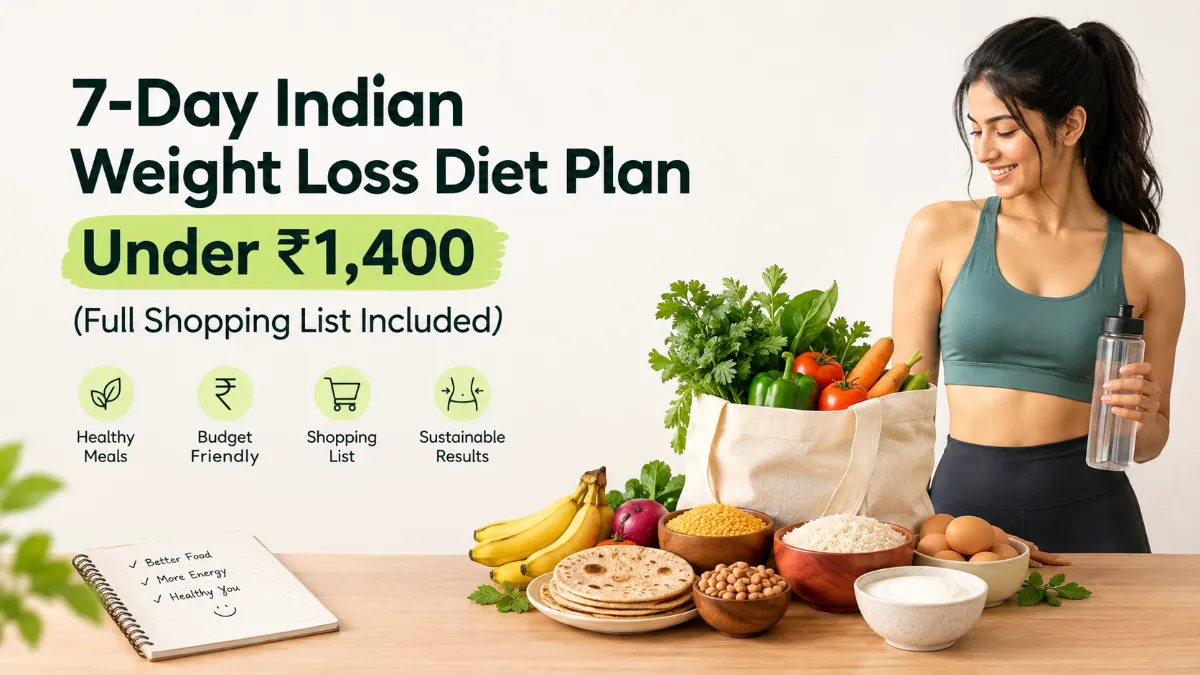
A budget weight loss diet in India does not require imported superfoods or protein powders. A ₹1,300 to ₹1,400 weekly grocery basket built around dal, seasonal vegetables, eggs or curd, whole wheat atta, and rice can support gradual weight management when paired with portion awareness and regular movement. The idea is a repeatable eating pattern, not a rigid seven-day script, and the pace of loss considered medically safe is slow: roughly half a kilogram to just under a kilogram a week.
Why Most Indian Diet Plans Skip the Budget Question
Search for an Indian diet plan for weight loss and you will find dozens of nearly identical seven-day charts. They differ mainly in which calorie tier they pick, usually somewhere between 1,200 and 1,800 kcal, and most hand you exact gram measurements for every meal.
Almost none of them tell you what the week actually costs.
That gap matters. I have spent over six years working in clinical diagnostics labs across India before building Sehatam, has seen how often people abandon a diet plan not because the food advice was wrong, but because it assumed a grocery budget they didn't have. A plan built around paneer, almonds, avocado, and imported oats is not wrong nutritionally. It is simply unusable for a large share of Indian households, and a diet that gets abandoned in week two does nothing for anyone's weight.
This article works from the other direction. Instead of starting with a calorie target and picking foods to hit it, it starts with a realistic weekly grocery budget, roughly what a single person in most Indian cities can spend on food for a week, and builds an eating pattern around what that money buys. Nothing here replaces a doctor or a registered dietitian. What it offers is a starting structure you can adjust to your own kitchen, your own region, and your own health situation.
What ₹1,400 a Week Actually Buys You
Grocery prices differ across Indian cities, and they shift with the season, especially for vegetables. The table below is built around typical staple prices tracked through the Department of Consumer Affairs' Price Monitoring Cell and government schemes such as Bharat Dal, which sells subsidized chana dal at a fixed rate of ₹60 per kg through its retail counters. Treat the totals as a working range rather than a fixed number, and check your local kirana or sabzi mandi prices before you shop, since a single vegetable going out of season can shift the weekly total by a hundred rupees or more.
Item | Approx. Quantity (1 person, 7 days) | Approx. Price Range | Notes |
|---|---|---|---|
Moong dal + chana dal (mixed) | 1 kg | ₹110–140 | Base protein for most lunches and dinners |
Whole wheat atta | 2 kg | ₹90–140 | Rotis through the week |
Rice (regular, non-basmati) | 1 kg | ₹45–65 | Paired with dal 2–3 times a week |
Seasonal vegetables (mixed) | 4–5 kg | ₹150–220 | Sabzi and salad; pick what's in season locally |
Eggs | 1 dozen | ₹75–95 | Skip or replace with extra dal/sprouts for a vegetarian version |
Curd or milk | ~2 litres equivalent | ₹90–130 | Breakfast, raita, and buttermilk most days |
Seasonal fruit (banana, guava, papaya, etc.) | 1.5–2 kg | ₹70–110 | Daily snack |
Peanuts, chana, or sprouts | 250–300 g | ₹40–60 | Evening snack instead of fried food |
Cooking oil (portion from a larger bottle) | ~250–300 ml | ₹45–65 | Tempering and light sautéing |
Tea, spices, salt (top-up) | As needed | ₹40–60 | Usually already stocked; small weekly top-up |
Added up, this basket typically lands somewhere between ₹950 and ₹1,300 for one person for a full week, which leaves headroom under the ₹1,400 target for local price differences, a non-vegetarian swap like chicken or fish once during the week, or a slightly larger fruit basket.
Two adjustments worth making before you shop: buy vegetables that are in season in your region, since off-season produce can cost two to three times more, and check whether your state runs a subsidized Bharat Atta, Bharat Rice, or Bharat Dal counter, since these government-backed retail points sell staples below open market rates.
The Science Behind This Pattern
Does India Have Official Guidance for a Plate Like This?
Yes. In May 2024, the ICMR-National Institute of Nutrition released its revised Dietary Guidelines for Indians, introducing a model called "My Plate for the Day." The guideline recommends that roughly half of a daily plate come from vegetables and fruit, about a quarter from whole grains or millets, and the remaining quarter from a mix of pulses, dairy, egg, fish, or lean meat, with a small allowance for nuts and healthy fats. That structure is close to what this plan follows: dal, a vegetable sabzi, a modest portion of roti or rice, and a protein source like egg or curd at most meals.
Why Lean So Heavily on Dal and Legumes?
Dal is not just the cheapest protein source in most Indian kitchens. It also has research behind it. A meta-analysis in the American Journal of Clinical Nutrition pooled 21 randomized controlled trials covering more than 900 overweight or obese adults and found that a daily serving of pulses, close to 130 grams, was associated with a modest reduction in body weight compared with diets that excluded them, even when no other dietary changes were made. The effect was small, about a third of a kilogram over an average of six weeks, so dal on its own will not produce dramatic results. What it appears to do is support satiety: legumes are high in fiber and protein relative to their cost, and that combination tends to reduce how much people eat at the following meal.
What About Skipping Rice and Roti Entirely?
You do not need to. The ICMR-NIN guidelines keep whole grains and millets as a core plate component rather than something to eliminate. Diet plans that ask Indian readers to give up rice and roti altogether are usually harder to sustain long term, partly because they cut against decades of eating habits built around these staples. A more workable adjustment is portion and grain choice: leaning toward millets or brown rice on some days, rather than removing staple carbohydrates outright.
Does the Order or Combination of Food Matter for Fullness?
There is some evidence for it. A study from the University of Copenhagen's Department of Nutrition, Exercise and Sports served 43 men protein-rich meals built either around legumes like beans and peas or around pork and veal, matched for calories. Participants who ate the legume-based meal went on to eat about 12 percent fewer calories at their next meal than those who ate the meat-based meal, and the researchers linked this to the higher fiber content of the legume meal rather than protein alone. It is a small study, and one trial on 43 men should not be read as a universal rule, but it lines up with the broader pattern seen across the larger pulse meta-analysis: fiber-rich, plant-based meals tend to carry more staying power per rupee than their calorie count alone would suggest.
A Sample 7-Day Eating Pattern (Not a Fixed Prescription)
This is a structure, not a script. Swap any vegetable, dal, or fruit here for what's fresh and cheap in your local market that week; the pattern matters more than the exact dish.
Day | Breakfast pattern | Lunch pattern | Dinner pattern | Snack pattern |
|---|---|---|---|---|
1 | Moong dal chilla with chopped vegetables | Mixed dal, seasonal sabzi, roti, salad | Light vegetable khichdi with curd | Roasted chana or a seasonal fruit |
2 | Vegetable poha or upma | Rajma or chana with rice, cucumber salad | Sabzi with roti, glass of buttermilk | Boiled egg or a bowl of sprouts |
3 | Besan cheela with mint chutney | Dal, seasonal sabzi, roti | Egg curry or paneer bhurji with roti | Fruit with a handful of peanuts |
4 | Two boiled eggs or a bowl of sprouts with a fruit | Curd rice or dal-rice with salad | Mixed vegetable sabzi with roti | Roasted makhana or a fruit |
5 | Oats with vegetables, savoury style | Dal, seasonal sabzi, roti | Leftover dal reheated with fresh tempering, roti | Buttermilk or a fruit |
6 | Idli, dosa, or moong dal chilla | Chana or rajma with rice, salad | Light vegetable soup with roti | Boiled egg or sprouts |
7 | Vegetable daliya or upma | Dal, sabzi, roti, curd | Khichdi with vegetables | Seasonal fruit |
Repeat or rotate this structure into a second week rather than treating it as a strict seven-day countdown that ends on day eight.
Many Indian households already cook dal and sabzi in bulk for two or three days at a time. This plan works well with that habit: pressure-cook a larger batch of dal early in the week, refrigerate it, and reheat with fresh tempering each day instead of starting from scratch every evening.
Adjusting the Pattern for Your Region
India does not eat one way, and a plan that only makes sense for a North Indian kitchen quietly excludes a lot of readers. The underlying structure, dal plus vegetable plus grain plus a protein top-up, holds across regions even when the specific dishes change.
● South Indian kitchens: swap wheat roti for idli, dosa, or ragi mudde on some days, and use sambar or rasam as the dal component instead of a North Indian-style dal.
● Bengali and Eastern households: a light machher jhol (fish curry) or a simple cholar dal can slot into the protein and dal roles without changing the overall structure.
● Gujarati and Western kitchens: dhokla, khichdi, or kadhi already fit this pattern closely; the main adjustment is watching added sugar in dals and chutneys, which some regional recipes include by default.
● Hostel or shared-kitchen situations: if cooking control is limited, the same principle applies at a mess or canteen counter: fill half the plate with sabzi and salad first, then add dal, then a smaller portion of rice or roti.
Making ₹1,400 Stretch Across the Week
● Buy vegetables twice instead of once. A single large shopping trip often means the vegetables at the bottom of the bag spoil before you reach them, especially leafy greens.
● Choose loose grains and pulses over branded packets where quality allows it. Loose atta and dal from a local mill or kirana store often run ₹10 to ₹20 cheaper per kilogram than pre-packaged branded versions.
● Lean on eggs over paneer if protein cost is tight. A dozen eggs is usually cheaper per gram of protein than an equivalent quantity of paneer.
● Make curd at home instead of buying single-serving cups or probiotic drinks.
● Cook once, eat twice. Extra rotis or rice from dinner can become part of breakfast the next morning with less oil and fewer dishes to wash.
Movement That Doesn't Cost Anything
Diet is only one half of the picture, and this plan does not prescribe a workout schedule, since the right amount and type of activity depends on a person's current fitness level and any existing joint or health conditions. What it can point to is that movement does not have to mean a gym membership.
A daily walk, taking stairs where available, standing up every hour during a desk job, or doing household chores at a slightly brisker pace all add up over a week. If you are new to exercise or have a joint, heart, or other condition, check with a doctor before starting anything more structured than walking, since the safe starting point varies a great deal from person to person.
What This Plan Deliberately Leaves Out
Several of the highest-ranking budget diet articles for this keyword include claims this piece will not repeat: promises of losing a fixed number of kilograms in a week, recommendations to drop below 800 calories a day without medical supervision, or cheat-day framing that swings between restriction and indulgence. None of these have solid evidence behind them for sustainable weight management, and very low-calorie eating without supervision carries real risk.
Protein powders and imported supplements are also absent here on purpose.
The ICMR-NIN 2024 guidelines specifically advise against routine use of protein supplements for muscle building outside of clinical need, citing evidence of risks such as bone mineral loss and kidney strain from prolonged high-dose protein powder use. Dal, eggs, curd, and paneer cover protein needs for most people at a fraction of the cost, without that risk profile.
How Much Weight Loss Is Realistic on This Budget
The Centers for Disease Control and Prevention frames healthy, sustainable weight loss as roughly 0.45 to 0.9 kilograms a week, achieved through a moderate reduction in intake rather than a large one. Losing weight faster than this is usually water loss rather than fat loss, and it tends to come back just as quickly.
India's own health data adds context for why gradual, food-based approaches matter here. National Family Health Survey data has shown close to a quarter of women of reproductive age in India are overweight or obese, alongside persistent rates of underweight and anaemia in the same population, a pattern researchers describe as a double burden of malnutrition. A diet that swings between very low-calorie phases and normal eating does not address that underlying pattern well. A steady, repeatable structure does more for long-term weight management than a dramatic short-term drop, even if it is less exciting to promise.
There is no version of this plan, or any other, that guarantees a specific number on the scale by day seven.
When a Budget Diet Plan Isn't the Right Tool
A grocery list and a meal pattern can support weight management. They cannot diagnose or treat a medical condition. If weight is not shifting despite consistent effort, or if you notice symptoms like unusual fatigue, hair thinning, irregular periods, or rapid weight changes in either direction, that combination is worth raising with a doctor rather than adjusting the diet plan further on your own. Conditions such as thyroid disorders or PCOS can affect weight independently of diet, and a lab test is the reliable way to check for them, not a checklist of symptoms.
Vishal's background is in clinical diagnostics, not clinical care, which is exactly why this section ends with "see a doctor" instead of a workaround.
Frequently Asked Questions
Can this diet work if I don't eat eggs, fish, or meat?
Yes. Dal, curd, and sprouted legumes cover the protein quarter of the ICMR-NIN plate model without any non-vegetarian ingredient, and they are usually the cheapest items on the shopping list.
Do I need to give up rice and roti to lose weight on an Indian diet?
No. National dietary guidelines keep whole grains as a core food group rather than something to eliminate. Portion size and grain choice matter more than cutting rice or roti out altogether.
Can I repeat this same 7-day pattern the following week?
Yes. Rotating it with seasonal vegetable swaps is more sustainable long term than designing a new plan from scratch every week.
Is dal alone enough protein, or do I need a protein powder?
For most people without a diagnosed medical need, dal combined with eggs, curd, or paneer covers protein needs, and ICMR-NIN guidelines advise against routine protein powder use outside clinical supervision.
What if my weekly grocery budget is higher or lower than ₹1,400?
The structure holds either way. A higher budget can add more protein variety like fish or paneer; a tighter budget can lean further into dal, seasonal vegetables, and eggs, which remain among the least expensive protein sources in most Indian markets.
Is it safe to follow a diet like this if I have diabetes or another existing condition?
This plan is written for general audiences and is not a substitute for medical advice. Anyone managing diabetes, thyroid disorders, PCOS, or another diagnosed condition should have a doctor or registered dietitian review portion sizes and food choices against their specific treatment plan before making changes.

Written By
Vishal Dhenwal
BSc Medical Lab Technologist with 6+ years of clinical diagnostic experience. Founder of Sehatam, translating lab-level clinical knowledge into free wellness guidance for Indians.
Read more about the author →Medical Disclaimer
This article is for informational purposes only and is not medical advice. Nothing here should be used to start, stop, or change any medication or treatment — always consult a qualified doctor first. Read our full disclaimer here.
Related Articles