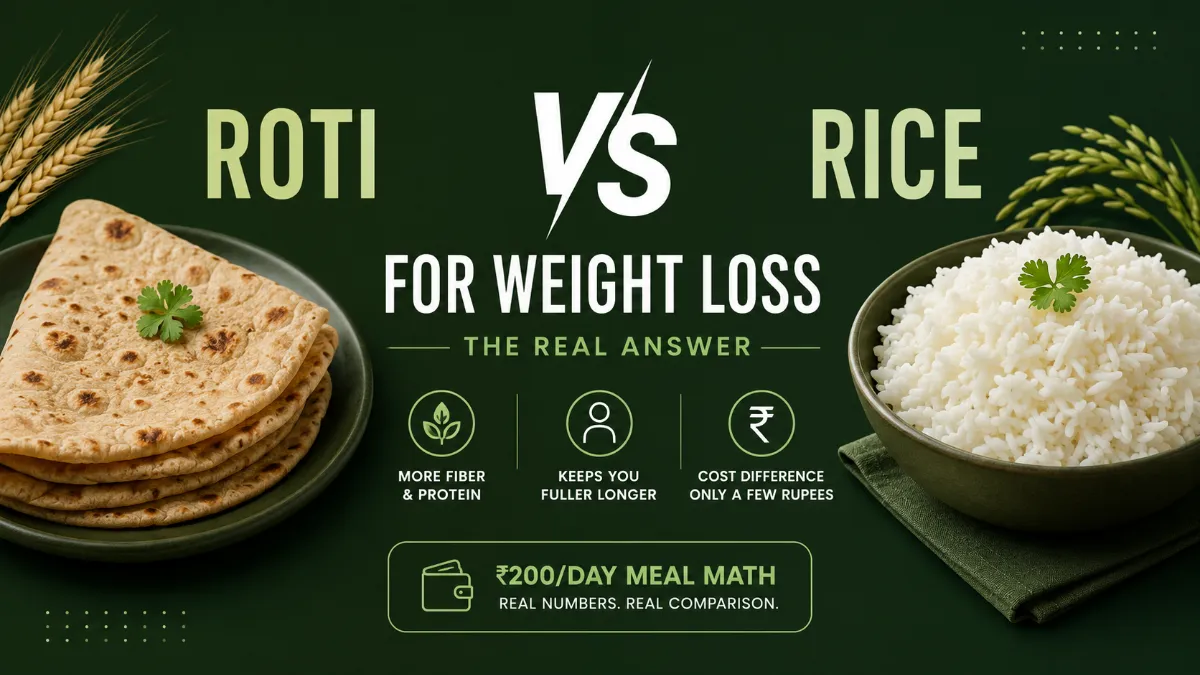
Quick Answer: Gram for gram, roti and rice contain almost the same calories, so neither one melts fat on its own. Roti (whole wheat) has more fibre and protein than white rice, which research links to feeling fuller for longer, and the price difference between building a day's meals around roti versus rice works out to only a few rupees. The real weight-loss lever is portion size and what sits next to the roti or rice on your plate, not which grain you pick.
Every second blog on this topic tells you roti wins because it has "more fibre." True, but nobody shows you the actual numbers, and almost nobody prices it out. Vishal Dhenwal, founder of Sehatam and a BSc Medical Lab Technologist who has spent over six years reading blood reports for a living, decided to run the numbers properly: what whole wheat flour and rice actually contain per 100 grams, what a real Indian satiety study found when it tested roti against rice-based food, and what it actually costs to build a day of meals around one versus the other in August 2026 Delhi retail prices.
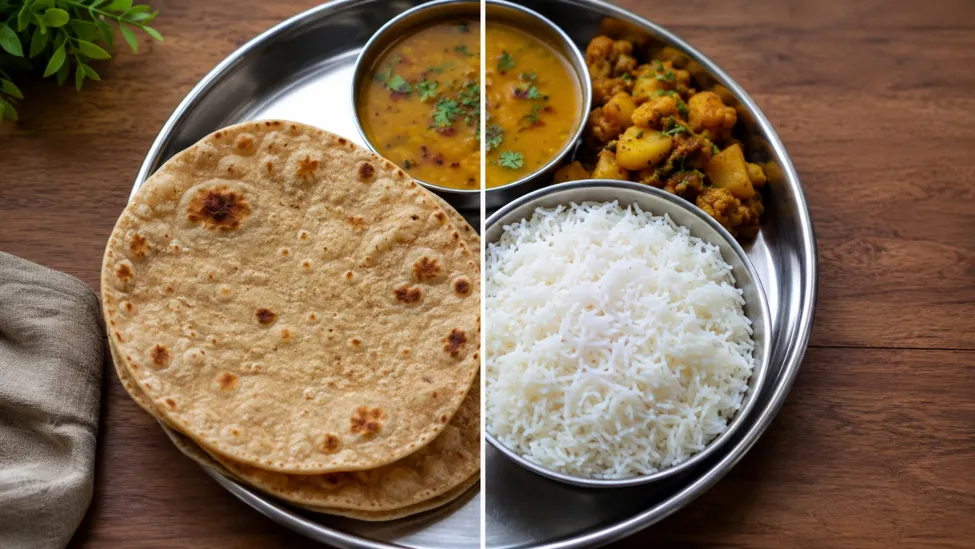
Roti and Rice Have Almost the Same Calories, Gram for Gram
Start with the raw ingredients, before oil, ghee, or serving size enters the picture. Whole wheat flour (atta) and raw milled rice are close enough in calorie density that neither one is a meaningful weight-loss shortcut by itself.
Nutrient (per 100g, raw) | Whole Wheat Flour (Atta) | White Rice (Raw, Milled) |
|---|---|---|
Energy | ~339 kcal | ~365 kcal |
Protein | ~13.7 g | ~7.1 g |
Dietary fibre | ~12.2 g | under 1.5 g |
Fat | ~1.9 g | ~0.7 g |
Carbohydrates | ~72.6 g | ~79 g |
These figures come from published food composition data (USDA FoodData Central and the ICMR-National Institute of Nutrition's Indian Food Composition framework), which both track raw wheat flour and raw milled rice as core Indian staple foods.
Rice is actually the slightly denser food calorie for calorie. What changes the picture is how each one behaves once it's cooked and eaten. Rice absorbs two to three times its raw weight in water, so a cooked cup looks and feels bigger than the same-calorie serving of roti dough. That is exactly why gram-for-gram comparisons mislead people, and why fibre and protein content, not raw calories, are where roti and rice genuinely diverge.
Where Roti Actually Wins: Fibre and Protein, Not Calories
The numbers above show it plainly. Whole wheat flour carries roughly eight times the fibre of raw milled rice, and close to double the protein. Neither fibre nor protein directly burns fat, but both influence how full a meal makes you feel and for how long, which is the actual mechanism behind most successful weight management.
Fibre slows gastric emptying and the rate at which glucose enters the bloodstream after a meal. Protein has a stronger effect on satiety hormones than either carbohydrate or fat, meal for meal. Rice, once milled and polished, loses most of the bran and germ layers that carried its own fibre and protein, which is precisely the difference a scale of nutrients this size would predict.
None of this means rice is unhealthy. It means a plate built mostly around white rice needs deliberate additions, dal, a vegetable serving, a protein source, to reach the same fibre and protein a roti-based plate gets closer to on its own.
There is a second, quieter difference worth naming: micronutrients. Milling strips away the bran and germ layers of rice along with most of its B-vitamins, magnesium, and iron. Whole wheat flour keeps those layers intact by definition, which is part of why whole grains generally score better on nutrient density per calorie than refined ones. This does not make either food a supplement replacement, but it is one more reason the two staples are not nutritionally interchangeable even when their calorie counts look similar on paper.
The Glycemic Index Argument Is Messier Than Instagram Makes It Look
Glycemic index (GI) measures how fast a food raises blood glucose compared with pure glucose. It is the most repeated argument for roti over rice, and it is also the most oversimplified one online.
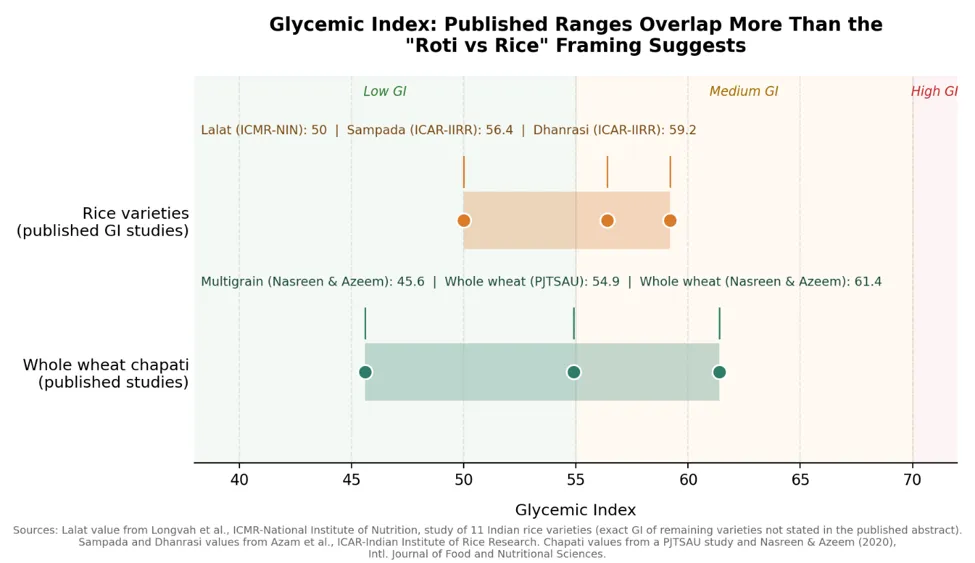
A study from the Department of Foods and Nutrition at PJTSAU tested chapati made from 100% whole wheat flour and measured a glycemic index of 54.9, a medium-GI result. A separate published study in the International Journal of Food and Nutritional Sciences, involving 17 healthy adults, found a basic whole wheat chapatti scored 61.41, while a multigrain version scored 45.61, a wide gap driven entirely by what went into the flour blend. That second study's sample size is small enough that the exact numbers should be read as indicative, not definitive.
Rice tells an equally split story. A peer-reviewed study by researchers at the ICMR-National Institute of Nutrition tested eleven Indian rice varieties and found that resistant starch content, not "white versus brown," explained nearly half the variation in glycemic index between them. One traditional variety, Lalat, tested at a low-GI 50, while the study's own abstract notes the remaining varieties tested higher without specifying an exact figure for each. A separate study by researchers at the ICAR-Indian Institute of Rice Research measured two other varieties, Sampada and Dhanrasi, at 56.4 and 59.2, both squarely in the medium-GI range typically claimed for chapati, not the high-GI range usually quoted for "rice" as a single category.
The honest summary: whole wheat chapati generally lands in the medium-GI range, roughly low-to-mid 50s through low 60s depending on the flour blend, while white rice varieties span a wider range and skew higher on average, but individual rice varieties and cooking methods can close that gap substantially. Treating either food as having one fixed GI number is not supported by the published data.
Cooking method adds another layer most comparisons skip entirely. Rice cooled after cooking and then reheated develops more resistant starch, a form the body digests more slowly, which measurably lowers its glycemic response compared with rice eaten fresh off the stove. The same applies to roti made a day in advance and eaten cold or reheated rather than fresh off the tawa. Neither food has a single, fixed glycemic identity. Preparation changes the number almost as much as the grain itself does.
Which Keeps You Fuller Longer? What a Mumbai Satiety Study Found
Calories and GI are proxies. What people actually care about is whether a meal keeps hunger away. A study out of SNDT Women's University in Mumbai, published in the journal Appetite, tested exactly this question using six breakfast items common in Indian households, comparing rice-based, wheat-based, and a fermented rice-pulse preparation against a white bread reference, in a group of 32 healthy young women.
Participants ate equal-calorie portions of each food and rated their hunger and fullness every 15 minutes for two hours. The ranking that emerged put a savoury broken wheat preparation and a whole wheat flatbread above a rice flakes preparation, with white bread scoring lowest of all. The researchers found that fibre content, energy density, and the cooked weight of the food, essentially how much physical volume it added to the stomach, predicted satiety scores. Fat and carbohydrate content did not.
This lines up with the fibre numbers from the nutrition table earlier. It also explains something the calorie-only comparisons miss: a roti-based meal, matched calorie for calorie against a rice-based one, is likely to leave you less hungry an hour or two later, because of its structure and fibre content, not because of some hidden metabolic advantage.
It is worth being precise about what this study does and does not show. It tested breakfast items specifically, not lunch or dinner thalis, and its subjects were 32 young women in one city, not a nationally representative sample. The direction of the finding, fibre-dense whole grain preparations outlasting a rice-based item on fullness, is consistent with the broader nutrition science on fibre and satiety, but the exact numbers belong to this one study and this one population, not to every roti and every rice dish eaten across India.
The ₹200/Day Meal Math: Roti Thali vs Rice Thali
Here is the part nobody else runs. As of August 2026, branded whole wheat atta retails in Delhi for roughly ₹45 to ₹55 a kilogram, and everyday non-basmati rice sits in a similar ₹40 to ₹50 a kilogram range, cheaper if you buy the government's subsidised Bharat Brand atta and rice, priced at ₹30 and ₹34 a kilogram respectively when the scheme is available in your area.
To compare the two staples on equal footing, take a day where the cereal staple, roti or rice, contributes about 900 kcal across three meals, a reasonable mid-range figure for how much of a day's energy the main grain typically supplies in an Indian thali. That 900 kcal figure is a starting point, not a personal target, so if you want your own number, it takes a couple of minutes to work out on BMR calculator. Using ₹50/kg atta and ₹45/kg rice as representative retail prices:
| Roti-based day (staple only) | Rice-based day (staple only) |
|---|---|---|
Raw quantity needed for ~900 kcal | ~265 g atta | ~247 g raw rice |
Cost of staple | ~₹13 | ~₹11 |
Protein from staple | ~36 g | ~18 g |
Fibre from staple | ~32 g | ~3 g |
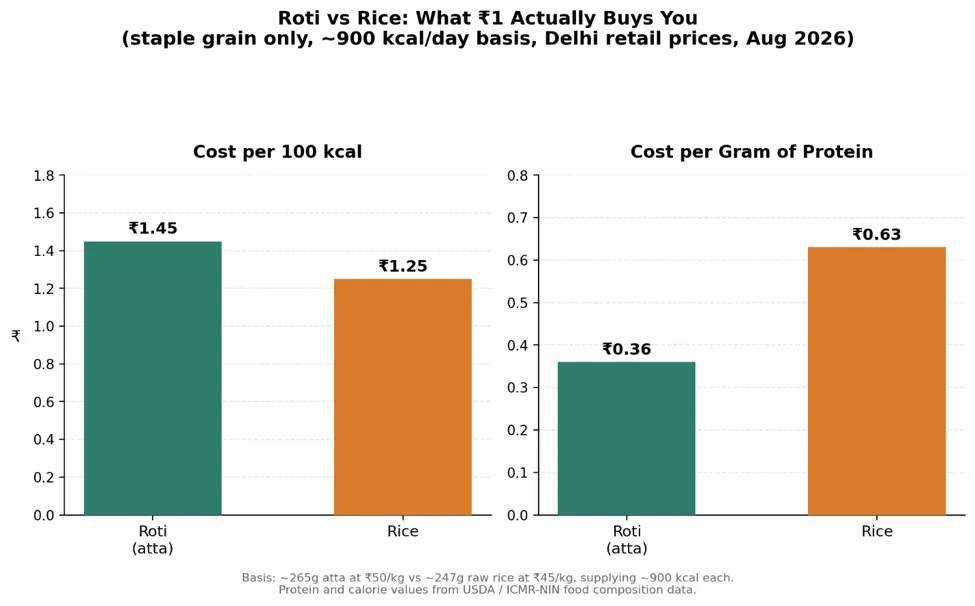
Cost per 100 kcal | ~₹1.45 | ~₹1.25 |
Cost per gram of protein | ~₹0.36 | ~₹0.63 |
Two things fall out of this table. First, the price gap between an all-roti and an all-rice staple base is small, about ₹2 a day at these prices. Anyone claiming rice is dramatically cheaper than roti, or the reverse, is not doing the arithmetic. Second, roti delivers protein at roughly half the cost per gram compared with rice, because of its fibre and protein density, not because atta itself is cheap.
Add a modest daily allowance for dal, a vegetable side, cooking oil, and spices, which typically runs somewhere in the ₹150 to ₹180 range per person at Delhi retail prices for a simple home-cooked thali, and a full day's meals land close to the ₹200 mark either way. The grain you choose barely moves the total bill. It moves the protein and fibre you get for that bill.
Two caveats keep this honest. First, these are illustrative figures built from published retail price ranges in one city at one point in time, not a fixed national number; prices in Chennai, Kolkata, or a small town in Bihar will differ, sometimes by a wide margin for rice varieties. Second, this math compares only the staple grain, not a finished dish. A plain roti and a bowl of plain rice cost close to what the table shows; a butter-laden paratha or a ghee-heavy pulao will cost, and calorie, considerably more than either baseline.
Portion Size Is Where the Real Weight Gain Happens
Roti's fibre edge only helps if portion sizes stay reasonable. A stack of six large parathas fried in ghee will out-calorie a modest bowl of steamed rice without any difficulty. Equally, rice eaten in a large single serving with little else on the plate loses whatever calorie advantage it had over roti, because that low energy density stops mattering once volume increases enough.
This is the part most competing articles gloss over. The GI table and the fibre numbers describe what happens per gram or per calorie. They say nothing about how many grams or calories actually land on the plate, and that is usually the bigger variable in whether a meal supports or works against a weight goal.
Household serving habits compound this. Many Indian households serve rice by the ladle rather than by weight, and roti by the piece rather than by the gram of dough rolled. Neither habit is wrong, but it does mean the actual calorie gap between a "rice day" and a "roti day" in a real kitchen often has less to do with the grain itself and more to do with how generous the hand serving it happens to be that day.
Where Brown Rice and Millets Fit In
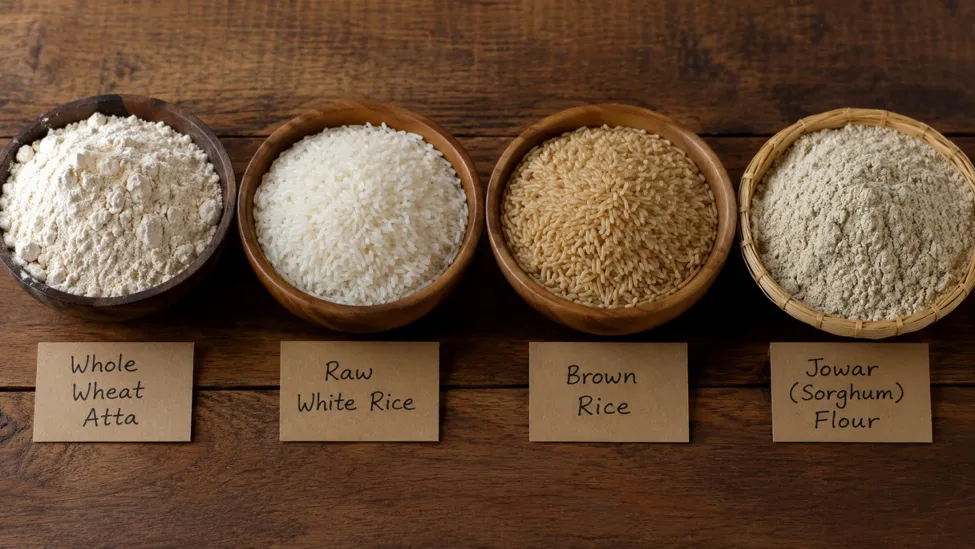
Brown rice retains the bran layer that white rice loses in milling, which raises its fibre content above white rice, though still below whole wheat flour gram for gram. Millet-based rotis, jowar, bajra, ragi, and blends with wheat, generally test lower on glycemic index than plain wheat chapati in published studies, largely because of differences in starch structure and fibre composition. Neither is a requirement for weight management. They are simply additional levers if someone wants more fibre from the same plate without changing the basic roti-or-rice structure of their meals.
So Which Should You Choose?
The research points to a narrow, specific advantage for roti: more fibre and protein per calorie, which published satiety data links to feeling full for longer after a meal. It does not point to rice being fattening or roti being a fat-burner. Both are staple carbohydrate sources, and the published evidence on glycemic index shows real overlap between the two categories once flour blends and rice varieties are accounted for.
What decides the outcome on a scale is the same thing it always is: how much ends up on the plate, how it's cooked, and what sits alongside it. A roti-based meal with generous dal, vegetables, and a modest oil quantity, or a rice-based meal built the same way, will behave very differently from either staple eaten in a large portion with little else.
If cost is a factor in the decision, the numbers above settle that question too. At August 2026 Delhi prices, choosing roti over rice, or the other way round, changes a day's grocery bill by a few rupees. It does not change it by enough to matter on its own. None of this replaces a plan built around your own numbers, portion sizes, plate structure, and consistency, which is the starting point of Sehatam's weight-loss program.
Roti vs Rice: Your Questions, Answered
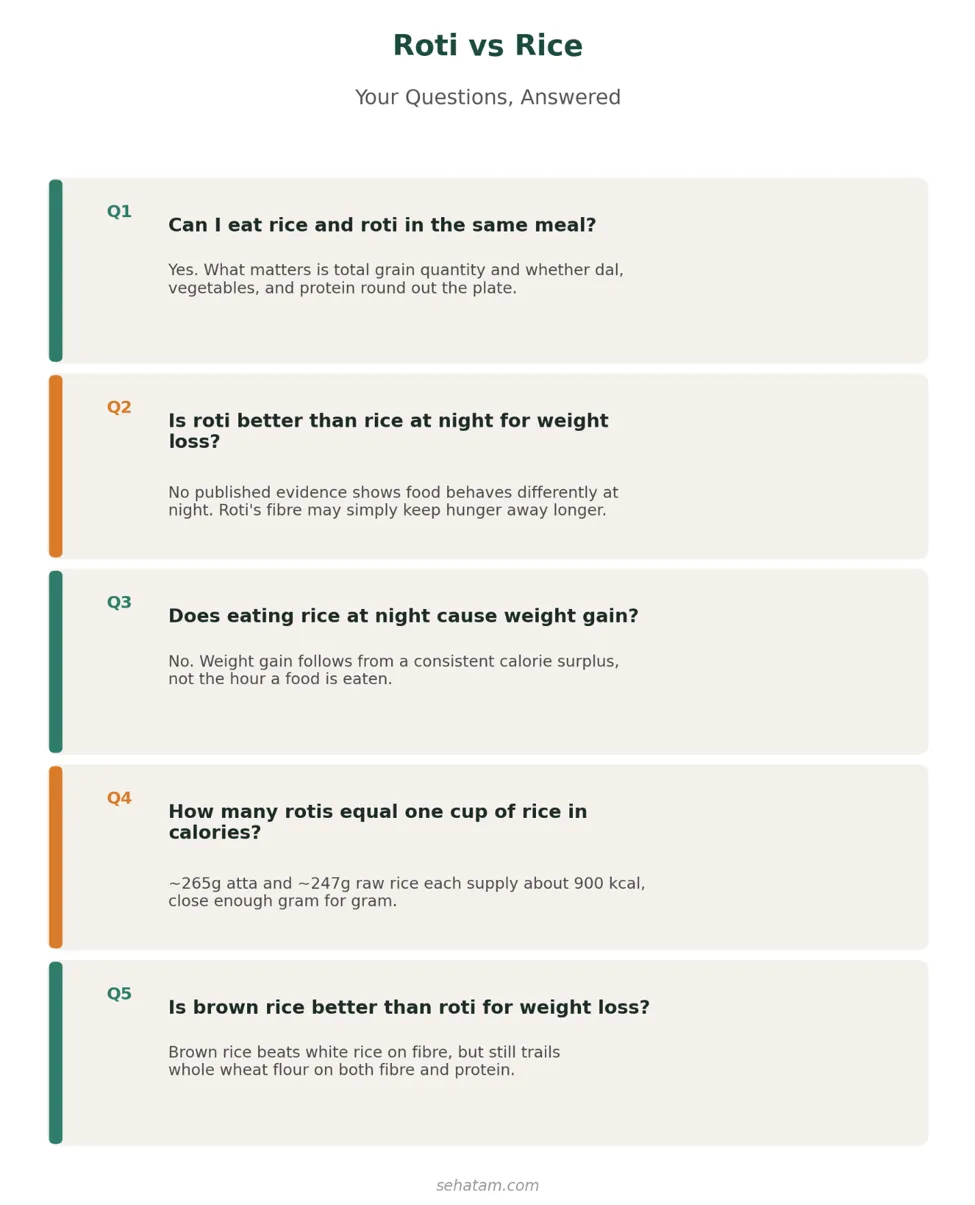
Can I eat rice and roti in the same meal?
Yes. There is no metabolic reason to keep them separate. What matters is the total quantity of grain-based carbohydrate on the plate and whether the meal includes enough dal, vegetables, and protein alongside it.
Is roti better than rice at night for weight loss?
There is no published evidence that the same food behaves differently metabolically at night versus during the day in a healthy adult. Roti's higher fibre content may keep hunger away longer through the night simply because it digests more slowly, which is the same mechanism that applies at any other meal.
Does eating rice at night cause weight gain?
Rice itself does not cause weight gain at any particular hour. Weight gain follows from consistently eating more calories than the body uses, regardless of what time those calories are eaten or which staple carbohydrate supplies them.
How many rotis equal one cup of rice in calories?
Using the raw-ingredient figures in this article, roughly 265 grams of atta and 247 grams of raw rice each supply about 900 kcal, so the ratio holds at smaller portions too: by weight, whole wheat flour and raw rice are close enough in calorie density that a same-calorie swap is mostly a matter of how many rotis your household typically rolls per 25 grams of dough, against how large a serving spoon delivers per cup of cooked rice.
Is brown rice better than roti for weight loss?
Brown rice has more fibre than white rice because it retains the bran layer, but published composition data still puts it below whole wheat flour on both fibre and protein per 100 grams. It is a reasonable middle option between white rice and roti, not a food that outperforms roti on the numbers covered here.

Written By
Vishal Dhenwal
BSc Medical Lab Technologist with 6+ years of clinical diagnostic experience. Founder of Sehatam, translating lab-level clinical knowledge into free wellness guidance for Indians.
Read more about the author →Medical Disclaimer
This article is for informational purposes only and is not medical advice. Nothing here should be used to start, stop, or change any medication or treatment — always consult a qualified doctor first. Read our full disclaimer here.
Related Articles