What is a Total Cholesterol Test?
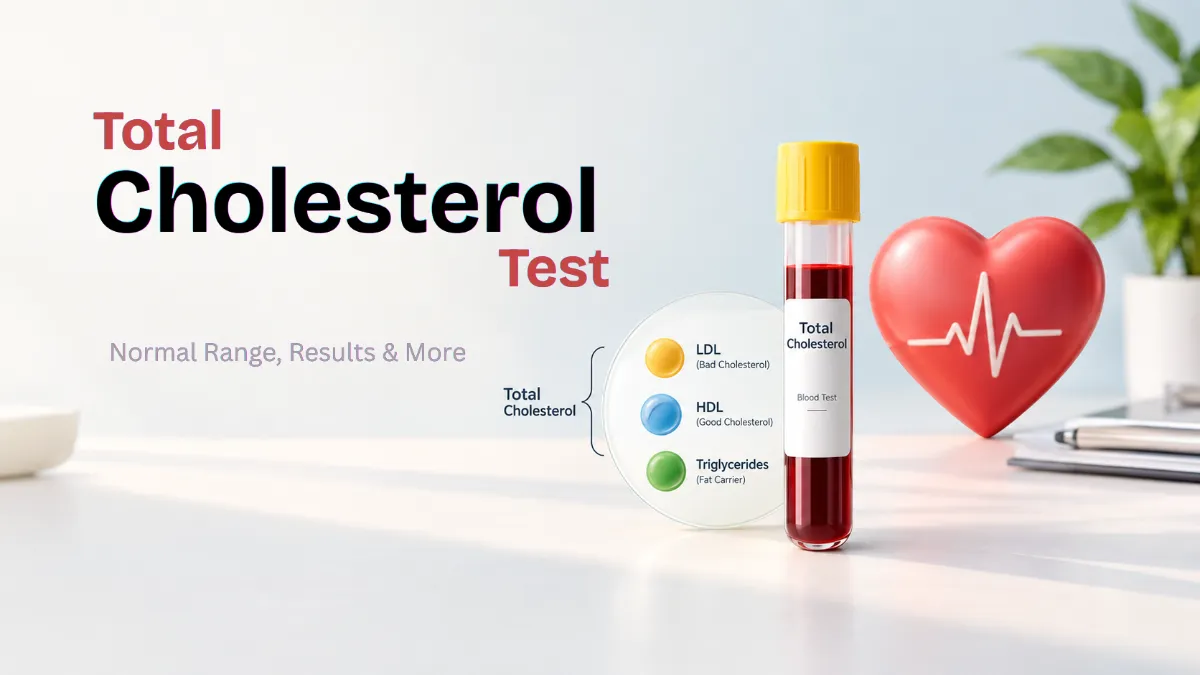
Cholesterol is a wax-like fat that your liver makes and your diet adds to. Every cell in your body needs a small amount of it to build cell membranes and produce hormones, so it is not something to eliminate, only to keep in balance. A total cholesterol test adds up the different types of cholesterol circulating in your blood: LDL, HDL, and the cholesterol carried in triglyceride-rich particles.
It gives your doctor a first, quick read on your long-term cardiovascular risk. The individual pieces, your LDL and HDL numbers, usually matter more for actual risk assessment, which is why total cholesterol is almost always ordered alongside a full lipid profile rather than on its own.
Why is Cholesterol Test done?
• To screen for cardiovascular risk before symptoms appear, since raised cholesterol rarely causes any noticeable signs on its own
• As part of a routine annual or periodic health checkup
• To track how well a cholesterol-lowering treatment or a lifestyle change is working
• To feed into a wider risk picture alongside blood pressure, blood sugar, and body weight
Raised cholesterol is recognised by the World Health Organization as one of the leading modifiable risk factors for heart attack and stroke worldwide. In India, this carries particular weight. Large national surveys coordinated by the Indian Council of Medical Research have found some form of abnormal blood lipid levels in the large majority of adults screened, with low HDL being the single most common pattern found across the country.
Who should get this test?
Talk to your doctor about a total cholesterol test if any of the following apply to you:
• You are over 18 and have never had your lipid levels checked
• You have a family history of heart disease, stroke, or high cholesterol
• You have diabetes, high blood pressure, or carry weight in the overweight or obese range
• You smoke, or your day-to-day routine involves very little physical activity
• You are already on cholesterol-lowering treatment and are due for a follow-up check
This test is a starting point, not a verdict. A single number does not by itself tell your doctor whether you are at risk. It is one input read together with several others.
How is the test done?
A total cholesterol test uses a blood sample, usually drawn from a vein in your arm. Some labs also offer a quick finger-prick version for screening purposes. Fasting requirements vary by lab and by what else is being measured. Many labs still ask for 9 to 12 hours without food before the draw when cholesterol is tested as part of a full lipid profile with triglycerides, while a standalone total cholesterol check can often be done without fasting. Ask your lab which applies to your specific order. The draw itself takes a few minutes, and results are typically ready within a day.
Normal Range
Parameter | Normal Range | Unit |
|---|---|---|
Adults (20 years and older) — Desirable | Less than 200 | mg/dL (below 5.18 mmol/L) |
Adults (20 years and older) — Borderline high | 200 to 239 | mg/dL (5.18 to 6.19 mmol/L) |
Adults (20 years and older) — High | 240 and above | mg/dL (6.22 mmol/L and above) |
Children and adolescents (2 to 19 years) — Acceptable | Less than 170 | mg/dL |
Children and adolescents (2 to 19 years) — Borderline | 170 to 199 | mg/dL |
Children and adolescents (2 to 19 years) — High | 200 and above | mg/dL |
Reference ranges can vary slightly between labs depending on their equipment and method — always check the range printed on your own report. International bodies such as the IFCC work on standardising how labs calibrate cholesterol assays, but small differences between instruments and reagents are still common.
What does a High result mean?
A high total cholesterol result is associated with a greater long-term risk of atherosclerosis, the slow build-up of fatty deposits inside artery walls. Over years, this narrowing can raise the risk of heart attack and stroke. High total cholesterol is often linked to diets high in saturated fat, low physical activity, excess body weight, and, in some families, an inherited pattern of high cholesterol known as familial hypercholesterolemia. It can also show up as a side effect of an underactive thyroid, kidney disease, or certain medicines.
A raised number on its own does not mean you have heart disease. Your doctor reads it together with your LDL, HDL, and triglyceride levels, plus your age, blood pressure, and family history, to work out your actual risk and whether any action is needed.
What does a Low result mean?
Low total cholesterol is uncommon and usually nothing to worry about. It can occur naturally in people with lean diets or very active lifestyles. Rarely, unusually low levels have been associated with an overactive thyroid, liver disease, malabsorption, or undernutrition, and some very low LDL levels are still being studied for weaker links to other health conditions. If your report shows an unusually low result, especially alongside other symptoms, raise it with your doctor rather than assuming it is automatically a good sign.
Factors that can affect results
• A heavy or fatty meal eaten shortly before a fasting test
• Alcohol consumed in the day or two before the test
• Acute illness, infection, or recent surgery, which can temporarily lower readings
• Certain medicines and supplements, including steroids and some hormonal treatments
• Pregnancy, which naturally raises cholesterol levels
• A significant recent change in body weight
How to Keep It in the Normal Range
• Build meals around vegetables, fruits, whole grains, and lean protein rather than heavily processed or fried food
• Stay physically active on most days of the week; brisk walking counts
• Work towards a healthy body weight for your height and frame
• Limit alcohol and avoid tobacco in any form
• Keep to the lipid-check schedule your doctor recommends, rather than waiting for symptoms
• Manage related conditions like diabetes and high blood pressure, since they influence cholesterol indirectly
None of this replaces medical advice, especially if you are already on cholesterol-lowering medicine. Any change to that treatment should go through your doctor, not a lifestyle adjustment made on its own.
Questions You May Be Wondering
Do I need to fast before a total cholesterol test?
It depends on the lab and what else is being tested alongside it. Fasting for 9 to 12 hours is still commonly asked for when cholesterol is tested as part of a full lipid profile with triglycerides, though several labs now accept non-fasting samples for a standalone total cholesterol check. Confirm with your lab before the appointment.
How often should I get my cholesterol tested?
This depends on your age and risk factors, and your doctor is best placed to set the interval for you. People with no known risk factors are often tested every few years starting in early adulthood, while those with diabetes, high blood pressure, or a family history of heart disease are usually tested more often.
Can my total cholesterol be too low?
Yes, though it is uncommon. Very low levels have occasionally been associated with certain health conditions, and researchers are still studying the connection. If your result comes back unusually low, discuss it with your doctor rather than treating it as automatically reassuring.
Why did two different labs give me slightly different cholesterol numbers?
Small variations between labs are normal and usually come down to differences in equipment, reagents, and calibration. The trend in your numbers over time matters more than any single reading.
Is total cholesterol the same as LDL or HDL?
No. Total cholesterol is the sum of LDL (often called the bad cholesterol), HDL (the good cholesterol), and a portion of your triglycerides. Two people can have the same total cholesterol number with very different LDL and HDL splits, which is why doctors look at the full lipid profile rather than the total figure alone.

Written By
Vishal Dhenwal
BSc Medical Lab Technologist with 6+ years of clinical diagnostic experience. Founder of Sehatam, translating lab-level clinical knowledge into free wellness guidance for Indians.
Read more about the author →Medical Disclaimer
This article is for informational purposes only and is not medical advice. Test ranges can vary by lab — always interpret your results with a qualified doctor. Read our full disclaimer here.