What is TSH Test?
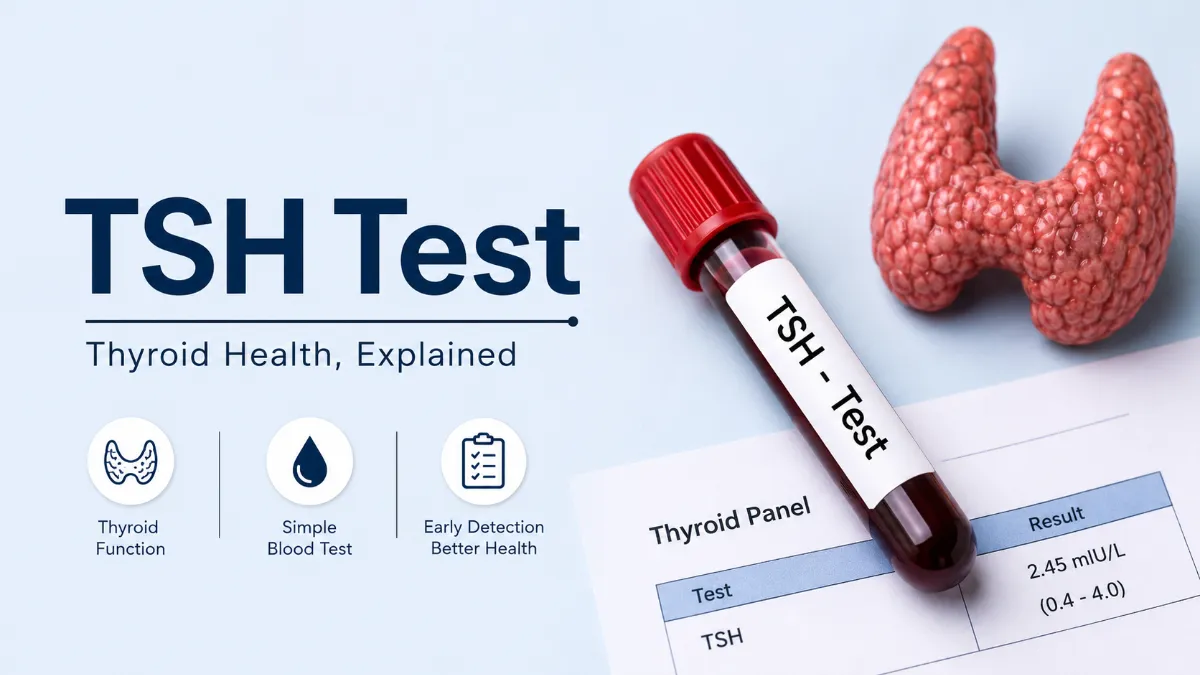
TSH, or Thyroid-Stimulating Hormone, is a hormone released by your pituitary gland, a small gland at the base of your brain. Its job is to tell your thyroid gland how much thyroid hormone to produce. A TSH test measures the amount of this hormone in your blood, and it is typically the first test doctors use to check how well your thyroid is functioning.
Because the pituitary and thyroid work in a feedback loop, TSH often shifts before you notice any symptoms, which makes this test useful for catching thyroid problems early.
Why is this test done?
• To screen for an underactive or overactive thyroid when specific symptoms are present
• As part of a routine health checkup, especially for women and older adults
• To monitor thyroid hormone replacement therapy in people already diagnosed with hypothyroidism
• To monitor treatment for an overactive thyroid
• To screen newborns for congenital hypothyroidism, a treatable condition that can affect brain development if missed
Who should get this test?
Talk to your doctor about a TSH test if you have noticed unexplained weight changes, ongoing fatigue, hair thinning, or shifts in mood or energy that do not have an obvious explanation. Irregular periods or difficulty conceiving are also common reasons doctors check thyroid function in women.
If thyroid problems run in your family, or you already have another autoimmune condition, your doctor may suggest periodic screening even without symptoms. In India, TSH screening is now part of routine newborn checks in many hospitals, since the Indian Council of Medical Research has reported that congenital hypothyroidism affects a meaningfully higher share of Indian newborns than the global average, and catching it early prevents developmental delay.
How is the test done?
A TSH test needs only a small blood sample, drawn from a vein in your arm. No fasting is required, and there is no special preparation beyond letting your doctor know about any biotin supplements or thyroid medication you are taking, since these can affect the reading. The draw takes a few minutes, and results are usually available within a day or two.
Normal Range
Parameter | Normal Range | Unit |
|---|---|---|
Adult (general) | 0.4 – 4.0 | mIU/L |
Pregnant Women, 1st Trimester | 0.1 – 2.5 | mIU/L |
Pregnant Women, 2nd Trimester | 0.2 – 3.0 | mIU/L |
Pregnant Women, 3rd Trimester | 0.3 – 3.0 | mIU/L |
Newborns (screening recall cutoff) | Below approximately 20 (lab-specific) | mIU/L |
TSH reference ranges vary by laboratory, testing method, age, and pregnancy status. Always interpret your result using the reference range printed on your own lab report.
TSH assays differ between manufacturers, and a single healthy person's usual level can sit anywhere within a fairly wide range. Some researchers have proposed a narrower target of roughly 0.5 to 2.5 mIU/L as more reflective of optimal thyroid function, though this is debated and has not replaced the standard reference range used by most labs.
What does a High result mean?
A TSH result above your lab's reference range is generally associated with an underactive thyroid, called hypothyroidism, since a high TSH usually means the pituitary is working harder because thyroid hormone levels are running low. The most common underlying cause is an autoimmune condition called Hashimoto's disease, in which the immune system gradually affects thyroid tissue.
Less often, elevated TSH points to a pituitary problem, or in someone already on thyroid medication, to a dose that is too low. A mildly elevated result, especially without symptoms, does not automatically call for treatment, and your doctor is likely to look at your free T4 level and how you are feeling alongside the number itself.
What does a Low result mean?
A TSH result below the normal range is generally associated with an overactive thyroid, called hyperthyroidism, where the thyroid produces more hormone than the body needs, so the pituitary responds by releasing less TSH. Graves' disease is the most common underlying cause.
Certain medications, non-thyroid illness, and the first trimester of pregnancy can also lower TSH temporarily without indicating a thyroid disorder. In someone on thyroid replacement therapy, a low reading can point to a dose that needs adjusting. As with a high result, your doctor typically looks at free T4 and T3 levels together with your symptoms before drawing conclusions.
Factors that can affect results
• Biotin supplements, common in hair, skin, and nail products, can distort TSH readings and are worth mentioning to your doctor before testing
• TSH naturally fluctuates through the day, running higher in the early morning and lower in the afternoon
• Acute illness or recent hospitalization can temporarily suppress TSH, unrelated to thyroid disease
• Certain medications, including steroids and some heart medicines, can shift results
• Early pregnancy can lower TSH temporarily, due to a pregnancy hormone that mildly stimulates the thyroid
How to Keep It in the Normal Range
Thyroid hormone production depends on adequate iodine intake, which is why the World Health Organization has long recommended universal salt iodization as a public health strategy, and why iodized salt is standard in most Indian kitchens today. Eating a varied diet that includes iodine sources such as dairy, eggs, and seafood, alongside the iodized salt already common in Indian households, supports normal thyroid function for most people.
Managing stress, prioritizing consistent sleep, and staying physically active all support the broader hormonal balance that keeps the pituitary-thyroid feedback loop working smoothly.
If you take biotin supplements or any thyroid medication, keeping your doctor informed helps ensure your results are read correctly. Regular checkups matter more than any single number, especially if you have a family history of thyroid disease or another autoimmune condition.
Questions You May Be Wondering
Do I need to fast before a TSH test?
No, fasting is not required. Some doctors prefer morning testing since TSH is naturally a little higher earlier in the day, but this is not a strict requirement for most routine tests.
Can stress affect TSH levels?
Significant physical or emotional stress and acute illness can cause temporary shifts in TSH, which is one reason your doctor may repeat a borderline result once you are feeling well, rather than acting on a single reading taken during a stressful period.
How often should TSH be tested?
This depends on your individual situation. People without symptoms or risk factors often do not need routine testing, while those on thyroid medication, pregnant, or managing a known thyroid condition are usually tested at intervals set by their doctor.
Is a slightly high TSH always a problem?
Not necessarily. A mildly elevated TSH with a normal free T4 is called subclinical hypothyroidism, and it does not always need treatment. Your doctor weighs your symptoms, other lab values, and how the number is trending over time.
Should I stop my thyroid medication if a TSH test comes back normal?
No, do not stop or adjust thyroid medication on your own. A normal TSH while on treatment usually means the current dose is working, and any changes should be made only by your doctor after reviewing the full picture.

Written By
Vishal Dhenwal
BSc Medical Lab Technologist with 6+ years of clinical diagnostic experience. Founder of Sehatam, translating lab-level clinical knowledge into free wellness guidance for Indians.
Read more about the author →Medical Disclaimer
This article is for informational purposes only and is not medical advice. Test ranges can vary by lab — always interpret your results with a qualified doctor. Read our full disclaimer here.